The Brilliance Trap: When Great Technology Isn't Enough
You’ve spent years perfecting your technology. Your solution is genuinely disruptive—perhaps a novel bioprocessing platform that could transform cell therapy manufacturing, or an AI-powered analytics tool that solves a problem enterprise teams didn’t even know they had.
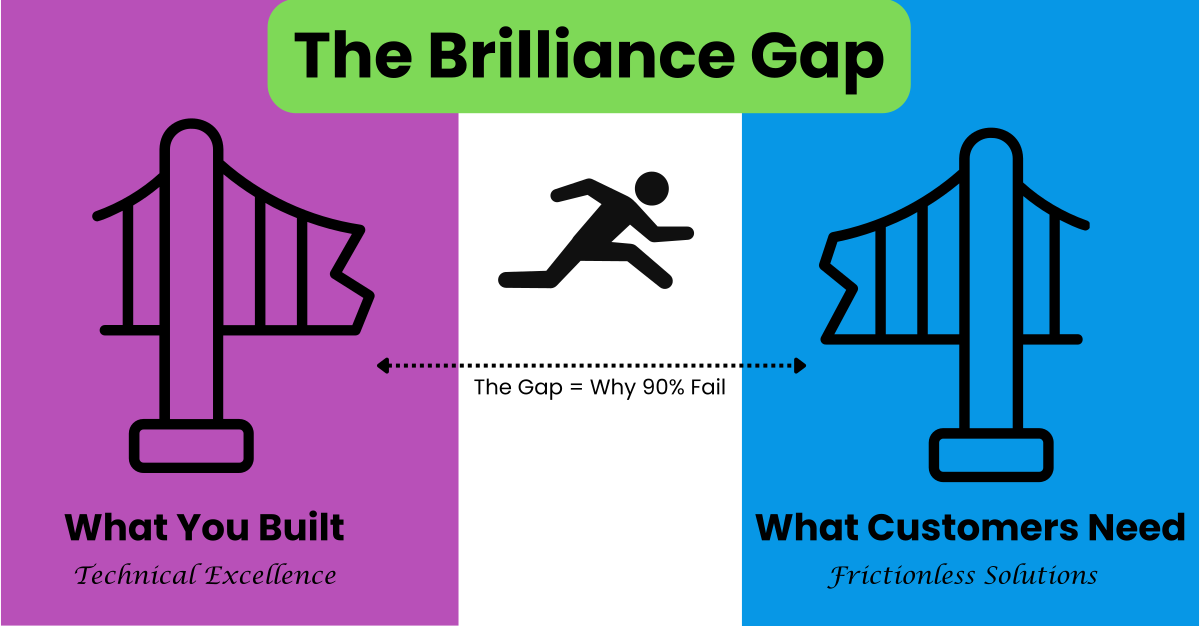
The technology is brilliant. So why aren’t customers lining up?
Here’s the hard truth I deliver to every technical founder I work with: Customer insight—really, truly, deeply understanding your customer’s needs, behaviors, and preferences—is the only path to sustainable growth and product-market fit.
Let me show you why this matters right now, across two very different industries.
The AI Hype Problem: Technology Without Customer Benefit
Technology startups today are dropping “AI” into their product descriptions like it’s a magic ingredient. They use it as a generic feature descriptor to signal “intelligence,” “progress,” or “future-proof technology”—a catch-all for sophistication that requires no further explanation.
But here’s what they’re not doing: explaining how they’re actually incorporating AI or why it truly benefits the end user.
I see pitch decks every week that say things like “Our AI-powered platform revolutionizes workflow optimization.” Okay, but how? Does your AI predict equipment failures before they happen? Does it automatically route samples based on urgency? Does it reduce manual data entry by 80%?
The startups riding this hype cycle are spreading a vague promise across every possible use case, hoping something sticks. What they’re missing is a simple, succinct narrative that answers: What specific problem does the customer have, and how does your technology uniquely solve it?
Eventually, the hype fades. The companies that survive are the ones who can clearly articulate the customer benefit—not just the technical sophistication. That’s what the customer discovery process reveals.
The Trust Breakdown in Biopharma: When Narrative Collapses
Or take what’s happening in biopharma and healthcare right now. Post-COVID, with shifting government policies and increased public scrutiny, the industry faces something it hasn’t dealt with at this scale before: widespread public resistance and skepticism.
People are questioning medications they’ve taken for decades—Tylenol fears, vaccine hesitancy, distrust of clinical trial data. These aren’t just PR problems you can solve with better advertising. They’re fundamental breakdowns in narrative and trust between companies and the people they’re trying to help.
Healthcare companies built their storytelling around scientific authority: “Trust us, we’re experts.” But when public trust in institutions erodes, that narrative collapses. They’re discovering they need to completely rethink how they communicate—meeting customers where they are emotionally, not just where the data says they should be rationally.
The companies that will succeed aren’t necessarily the ones with the best science (though that helps). They’re the ones who can rebuild trust through transparent, empathetic narratives that acknowledge customer fears and address them directly. And achieving this requires deep customer insights from systematic market research.
The Common Thread: Technology Alone Never Wins
Both examples point to the same truth: Technology alone never wins. The narrative that connects technology to customer need wins.
This is where most technical founders struggle. You’ve been trained to optimize for technical excellence—the most elegant algorithm, the most robust manufacturing process, the most novel mechanism of action. You’ve spent years in the lab or in development perfecting the how.
But customers don’t buy technology. They buy solutions to problems they’re actively experiencing—and achieving product-market fit requires understanding these problems deeply. And if you can’t articulate that solution in language they understand, addressing concerns they actually have, your brilliant technology stays on the shelf.
Why Technical Founders Struggle With Customer Discovery
Most technical founders I work with (Experienced engineers, PhD scientists, domain experts) are already wearing too many hats—managing operations, fundraising, legal, HR, and building the product. They lean heavily on their domain expertise when defining their target market.
The problem? Domain expertise ≠ customer insight.
Here’s what happens when you skip proper startup customer research:
- You assume you know what customers need (because you’ve been in the industry for years)
- You design for the “perfect” technical solution rather than the “good enough” customer solution
- You avoid the uncomfortable work of talking to strangers who might tell you your baby is ugly
- You mistake anecdotal feedback from 2-3 conversations for validated market research
This explains why 90% of startups fail, often due to lack of market need—not lack of technical excellence.
So what should you be doing instead? Let’s walk through the customer discovery framework that actually works.
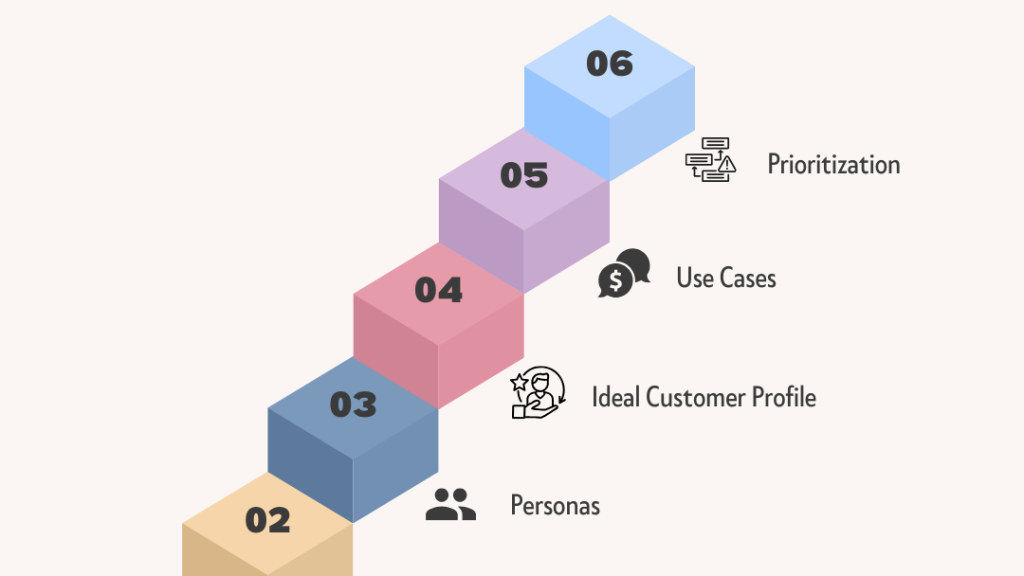
The 6-Step Customer Discovery Process (That Most Founders Skip)
The customer discovery process isn’t just “talking to customers.” It’s a systematic framework that answers two fundamental questions:
- WHO is your customer? (Your Ideal Customer Profile)
- HOW will they use your solution? (Your prioritized use cases)
Here’s the customer discovery framework successful founders follow:

Step 1: Conduct Quantitative and Qualitative Research
Start by developing a holistic understanding of your target market through both research methods:
Quantitative Research helps you understand:
- Market size and growth trends
- Industry dynamics and pain points at scale
- Pricing sensitivity and budget allocation
- Current solution adoption rates
Qualitative Research helps you understand:
- Why customers make the decisions they make
- The emotional and rational factors in buying decisions
- The language customers use to describe their problems
- The political and organizational dynamics at play
The goal: Build a comprehensive picture of your market before narrowing down to specific customer segments. Together, these methods provide the customer insights needed for market validation.
Step 2: Identify Key Market Segments (Customer Segmentation)
Based on your startup market research, identify distinct market segments that could potentially benefit from your solution.
For example, if you’re building bioprocessing equipment, your customer segmentation might include:
- Large biopharma companies
- Mid-size biotech firms
- Early-stage biotechs
- Contract development and manufacturing organizations (CDMOs)
- Academic research institutions
Each segment has different needs, budgets, buying processes, and pain points. Don’t skip this step—you need to see the full landscape before choosing your target market focus.
Step 3: Develop Multiple Customer Profiles (Personas)
For each promising segment, develop detailed customer profiles that include:
Demographics & Firmographics:
- Job titles and roles
- Company size, type, and stage
- Industry vertical
- Geographic location
- Budget authority and influence
Needs & Goals:
- What they’re trying to accomplish
- Key performance metrics they’re measured on
- What success looks like in their role
- What keeps them up at night
Roadblocks & Frustrations:
- Why current solutions aren’t working
- Organizational barriers they face
- Budget or resource constraints
- Risk factors that influence decisions
Buying Behavior:
- How they currently solve this problem
- Who else is involved in decisions
- What triggers a search for new solutions
- Decision criteria and timeline
At this stage, you should have 3-7 well-defined customer profiles. This isn’t the time to narrow down—you want options to evaluate.
Step 4: Prioritize to Select Your ICP (Ideal Customer Profile)
Now comes the hard part: choosing your primary target. Your Ideal Customer Profile (ICP) is the single customer type you’ll focus on first.
This is where most founders fail in their customer discovery process—they skip prioritization.
Prioritize based on:
Market Factors:
- Size of the segment (enough customers to build a business?)
- Urgency of need (are they actively looking for solutions?)
- Budget availability (can they afford your solution?)
- Competitive intensity (how crowded is this space?)
Your Constraints:
- Time to first revenue (how long is the sales cycle?)
- Proof required (do they buy from unproven vendors?)
- Technical readiness (can you serve them now with your MVP?)
- Team strengths (do you understand this customer deeply?)
Strategic Considerations:
- Beachhead potential (can you dominate this segment?)
- Expansion path (does winning here open doors elsewhere?)
- Reference value (are these customers influential in the market?)
- Learning velocity (will you learn quickly from these customers?)
The output: ONE clearly defined ICP. This is your answer to “WHO is your customer?”
Lorem ipsum dolor sit amet, consectetur adipiscing elit. Ut elit tellus, luctus nec ullamcorper mattis, pulvinar dapibus leo.
Step 5: Develop Use Cases for Your ICP
Now that you know WHO your customer is through the customer discovery process, figure out HOW they’ll use your solution.
Develop specific use cases that describe:
- The situation or context when they’d use your product
- The specific task or problem they’re solving
- The workflow or process involved
- The outcome they’re trying to achieve
- The value they get from using your solution this way
For a single ICP, you might identify 5-10 potential use cases. List them all.
Step 6: Prioritize Your Use Cases
Not all use cases are created equal. This is the second critical prioritization step in the customer discovery framework.
Rank them based on:
Customer Impact:
- How critical is this use case to the customer?
- How frequently will they use it this way?
- How much value does it create for them?
Your Capability:
- Can you deliver this use case with your current product?
- How much development work is required?
- Do you have the expertise to support it?
Market Dynamics:
- How well do competitors address this use case?
- Is this a recognized need or are you creating a new category?
- What’s the urgency around this use case?
The output: Your top 1-2 use cases. These become the foundation of your positioning and messaging—and your path to product-market fit.
This is the complete customer discovery process. It’s systematic, research-based, and forces you to make explicit choices about WHO you’re serving and HOW you’re helping them.
Most technical founders complete steps 1-3 (the research), but skip steps 4 and 6—the prioritization steps—and that’s where they get into trouble.
The 80/20 Rule You're Probably Violating (And Why It's Killing Your Traction)
Here’s the mistake I see constantly: Founders do the customer discovery process research, develop the profiles, identify the use cases… but then refuse to prioritize.
Instead of picking their top ICP and top 1-2 use cases, they hedge their bets. They try to serve multiple customer segments simultaneously. They build features for every possible use case. They spread their value proposition across 5-7 personas hoping to maximize revenue potential.
When you skip prioritization in your customer discovery process, you’re essentially trying to pursue every opportunity at once.
The result? A diluted value proposition that makes all use cases weaker and prevents product-market fit.
Why Smart Founders Still Make This Mistake
I get it. You’ve done the startup market research. You’ve identified 4-5 viable customer segments and 8-10 compelling use cases. The revenue potential looks attractive across all of them. Choosing just one feels like leaving money on the table.
Plus, what if you choose wrong? What if the segment you pick doesn’t convert? Isn’t it safer to keep your options open?
No. It’s not safer. It’s the path to mediocrity.
What Actually Happens When You Don't Prioritize
Your messaging becomes vague: “We help biotech companies streamline their workflows” could mean anything to anyone. When you try to speak to everyone in your target market, you connect with no one.
Your product roadmap gets scattered: You’re building features for 5 different personas. None of them get the depth they need. You’re always “almost good enough” but never exceptional for anyone.
Your sales cycles get longer: Prospects can’t figure out if you’re really built for them or if they’re just one of many segments you’re trying to serve. Without conviction in your positioning, they can’t develop conviction in you.
Your marketing budget gets wasted: You’re creating content for multiple personas, buying ads targeting broad audiences, attending conferences for different segments. You’re spreading your limited resources too thin to make an impact anywhere.
Your team gets confused: Different team members start using different language to describe what you do and who you serve. Your pitch deck says one thing, your website says another, and your sales team is telling yet another story.
The Fix: Ruthless Prioritization in Your Customer Discovery Process
So how do successful founders avoid this trap? Through ruthless prioritization.
Here’s what winning founders do differently:
They pick ONE ICP based on:
- Runway: Fastest path to revenue with current product readiness
- Revenue: Highest revenue potential they can realistically capture
- Strategic value: Opens doors to other segments once proven
They pick 1-2 use cases based on:
- Customer urgency: The problem that hurts most, right now
- Your differentiation: Where you’re 10x better, not 10% better
- Proof point: What you can deliver and demonstrate today
Then they go deep:
- All messaging speaks to this ONE target market’s specific pain points
- All product development serves these 1-2 use cases exceptionally well
- All marketing targets this ONE segment with precision
- All sales conversations follow the same narrative
This customer discovery framework demands focus—but focus is what creates traction.
This Doesn’t Mean Forever (The Beachhead Market Strategy)
You’re not married to this choice forever. Think of it as your beachhead market—the first segment you’ll dominate before expanding.
The pattern successful startups follow:
- Dominate one narrow segment with one specific use case
- Build undeniable proof and customer testimonials
- Expand to adjacent segments or add use cases from position of strength
- Repeat
The beachhead market strategy turns the customer discovery process into a growth engine.
The 80/20 Rule in Action: Why Focus Wins
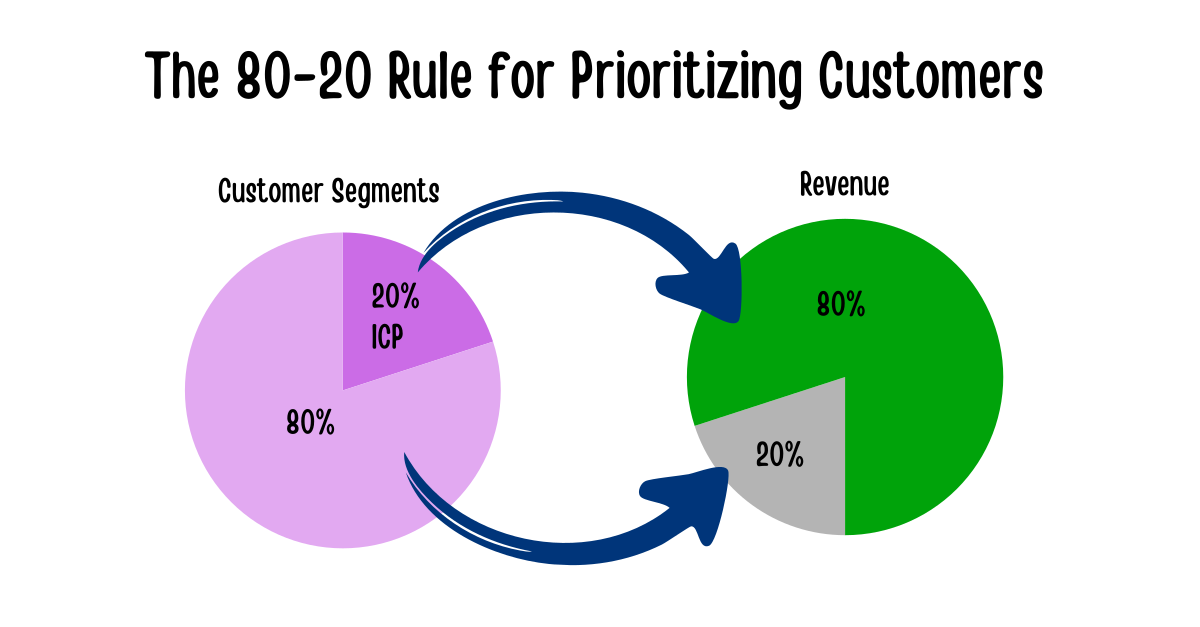
80% of your results will come from 20% of your customer segments. 80% of your value will come from 20% of your use cases.
The founders who win are the ones who:
- Use the customer discovery process to identify the right 20%
- Have the discipline to ignore the other 80% (at least initially)
- Go deep enough on the 20% to achieve dominance and product-market fit
The founders who struggle are the ones who:
- Do the startup market research (good!)
- Identify all the opportunities (also good!)
- Try to serve all of them at once (fatal mistake)
So ask yourself: Have you truly committed to ONE ICP and 1-2 use cases? Or are you still hedging your bets?
If different team members describe your target customer differently, if your pitch deck lists 3+ personas as “target markets,” if your roadmap tries to serve multiple segments equally—you’re violating the 80/20 rule.
Make the tough choice now. Pick your beachhead. Commit to it fully for the next 6-12 months. You can always expand later, but you need to win somewhere first.
How long does customer discovery take?
For most startups, the complete customer discovery process takes 4-6 weeks: 1 week for research and customer segmentation, 2-3 weeks for 10-15 interviews, 1-2 weeks for analysis and prioritization.
Can I do customer discovery without a product?
Absolutely. In fact, it’s better to do customer discovery before building. You’re validating the problem, not the solution. This is how you achieve product-market fit faster.
What if I don’t have time for 10-15 interviews?
You can start with a minimum of 5 interviews for your startup market research. You’ll see initial patterns, but add more interviews until 70%+ mention the same core problems. Quality customer discovery can’t be rushed.
Should I hire someone to do customer discovery?
Founders should do the first 5-10 interviews themselves in the customer discovery process. You’ll learn nuances no consultant can capture. After that, you can outsource synthesis and analysis.